API & System Integration
Connect Your Systems Into One Working Digital Ecosystem
We integrate ERP, CRM, HRMS, payment services, legacy applications, and custom platforms through reliable APIs and integration patterns, helping information move where it is needed.

"Your ERP, CRM, and payment system know something that the other doesn't—that is how integration allows you to connect them."
Any disintegrated solution you use within your organization represents a point at which someone re-enters data that is already present elsewhere. JBAS integrates your ERP, CRM, HRMS, payment solutions, and legacy systems through safe APIs, ensuring that data flows automatically instead of being manually exported and entered. The end product is a fully functioning ecosystem, rather than an array of disjoined systems sitting side by side.
What We Build
4 categoriesERP/CRM/HRMS Integrations
Direct seamless integrations between your key business systems, ensuring consistency throughout all your records.
REST & GraphQL
APIs compliant with the standard best suited for your data and consumption from other applications.
Payment Gateways and Services APIs
Secure integrations with payment providers built for reliability.
Legacy Systems Integration
Interfaces connecting legacy systems to modern applications without a big switch-over process.
Core Capabilities
5 capabilitiesCustom APIs created specifically according to your data model and business rules.
Exchange of data between two or more platforms without any manual intervention in-between.
Event-based triggers that send updates immediately upon change.
Secure access through tokens at every connection point.
Maintaining records consistent across platforms, with no duplicate entries.
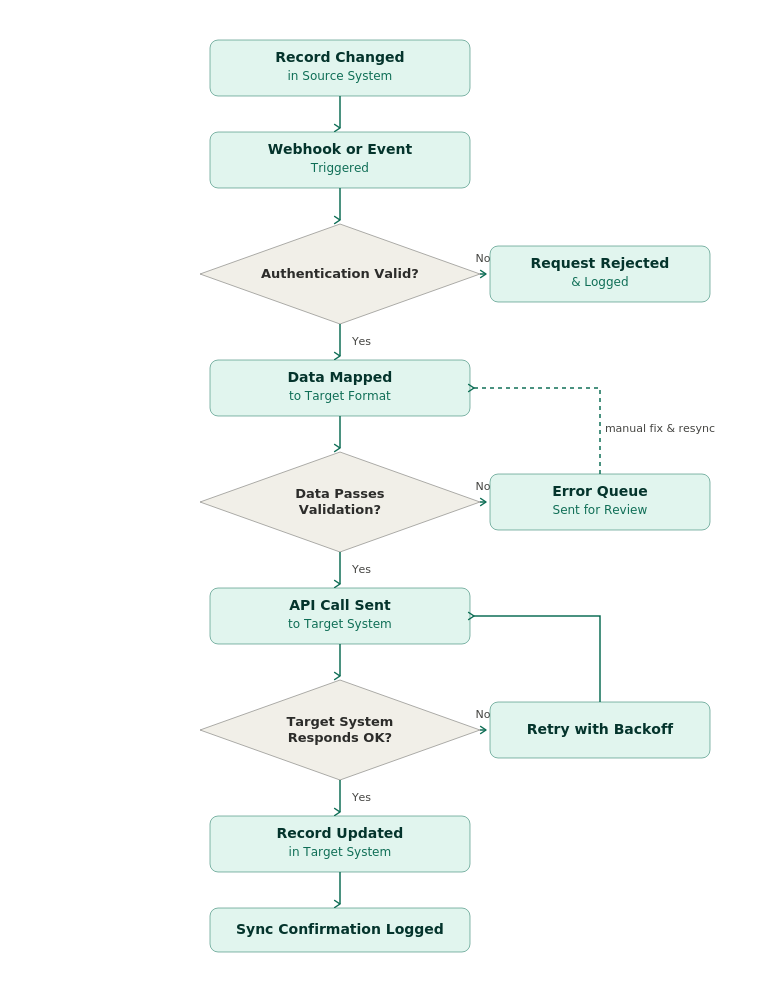
How Data Transfer Between Two Linked Systems
This is what happens the very instant a change occurs in one system, and data transfer to another system becomes necessary. All steps involved are monitored so that in case of any error, you can pinpoint where and why it occurred, rather than detecting the out-of-sync data. Here is the workflow:
Advantages
Why it mattersDecreased Manual Work
The data is transmitted automatically, eliminating copy-pasting from one system to another.
Elimination of Misfits
With the help of validation and synchronization, all of the information will be consistent everywhere.
Faster Operations
Any operation done in one system will trigger changes in other systems immediately rather than waiting for the export process.
Improved Awareness of Failures
An error log provides detailed information about where the sync went wrong.
Future Potential for Growth
Additional systems and applications may be added without affecting what already works.
Technologies that We Use Mainly
Under the hoodREST and GraphQL, which were developed in line with data exchange specifications of each particular system.
Webhooks and event-driven triggers that help integrate systems and make them communicate in real time.
OAuth 2.0 and token-based access control for every single point of integration.
Node.js, Python, and Java are used to develop and host integration logic.
Unified loggers tracking all synchronization processes and retries and failures in one place.
Frequently Asked Questions
5 questionsWhat kinds of systems can you integrate?
ERP, CRM, HRMS, payment gateways, legacy applications, and custom platforms, connected through REST, GraphQL, or webhook-based APIs.
Will integration disrupt our current systems?
No. JBAS builds connections around your existing tools, so you keep using what already works.
What happens if a sync fails midway?
Failed records go to an error queue for review while valid retries happen automatically with backoff.
Is data secure while moving between systems?
Yes. Every connection uses token-based authentication, and all activity is logged for review.
Can you connect older, legacy systems too?
Yes. JBAS builds bridges for legacy platforms so they can participate in the same data flow as modern tools.
Ready to implement api & system integration?
Tell us a bit about what you need — our engineering team will get back to you to scope the project and next steps.